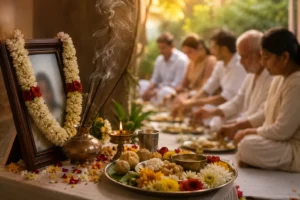
Death in Hinduism is not viewed as an ending but as a transition; a pivotal moment in the soul’s eternal journey through cycles of birth, death, and rebirth. Hindu funeral rites, known as Antyeshti or last rites, are among the most important samskaras (sacraments) in a person’s life.
These sacred ceremonies are designed to help the departed soul (atman) leave the physical body peacefully and continue its spiritual journey toward moksha, or liberation from the cycle of reincarnation.
Understanding what happens at a Hindu funeral can help families navigate this profound experience with greater clarity and reverence, whether you’re preparing for a loved one’s final journey or simply seeking to understand this ancient tradition.
The Moments Before Death: Preparing for Transition
Hindu tradition places great importance on the moments surrounding death. Ideally, a dying person is placed on the floor with their head facing east, symbolizing the rising sun and new beginnings. Family members gather to chant mantras or passages from sacred texts. The goal is to fill the dying person’s consciousness with sacred thoughts, as Hindus believe one’s final thoughts influence the soul’s next destination.
Holy water may be placed in the person’s mouth, and a Tulsi (holy basil) leaf is sometimes offered. These acts are believed to purify the departing soul. Once death occurs, the body is treated with profound reverence as the vessel that housed the eternal soul throughout its earthly journey.
Immediate Preparations: Honoring the Physical Form
Following death, specific rituals begin immediately. The body is bathed by family members, traditionally by those of the same gender as the deceased, using water mixed with sandalwood paste, turmeric, or other purifying substances. This ritual bath cleanses the body both physically and spiritually, preparing it for its final journey.
After bathing, the body is dressed in new clothes. For men, this typically means a dhoti or simple white garments; for women, a sari, often in their wedding colors if they were married. Married Hindu women are adorned with traditional symbols of marriage including vermillion (sindoor), bangles, and other customary ornaments, honoring their status as a wife.
The body is then placed in a simple casket or on a bier, often made of bamboo. Fresh flowers, usually marigolds and roses, are arranged around and upon the body. Sandalwood paste may be applied to the forehead, and sacred threads or beads might be placed on the body. Throughout these preparations, family members and visitors pay their respects, often touching
the feet of the deceased as a final gesture of reverence.
The Wake and Viewing: Community Support
Unlike some traditions that extend viewings over several days, Hindu funerals typically proceed quickly, ideally within 24 hours of death. This urgency stems from both religious requirements and practical considerations. The body remains at home or in a funeral facility for a brief period, allowing close family and friends to gather and say their farewells.
During this time, the atmosphere is filled with the chanting of mantras and devotional songs (bhajans). Incense burns continuously, creating a sacred environment. Visitors arrive to offer condolences to the family, though overt displays of grief are sometimes discouraged, as excessive mourning is believed to hinder the soul’s peaceful departure.
The immediate family, particularly the chief mourner, begins to follow specific protocols. They typically wear simple white clothing, avoiding any bright colors or elaborate dress. Shoes are removed when approaching the deceased, maintaining the purity of the sacred space.
The Funeral Procession: Journey to the Cremation Ground
When the time comes for cremation, the body is carried in a procession to the cremation ground or crematorium. Traditionally, male family members and friends carry the bier on their shoulders, walking in a solemn procession. The chief mourner, typically the eldest son of the deceased leads the procession. If the deceased had no sons, another close male relative, or increasingly in modern practice, a daughter may assume this role.
As the procession moves forward, mourners may chant “Ram Nam Satya Hai” (The name of Ram is truth), a powerful mantra affirming the eternal nature of the soul versus the temporary nature of the physical body. In some traditions, the procession circles the body or the home three times before departing, symbolically allowing the soul to take leave of its earthly dwelling.
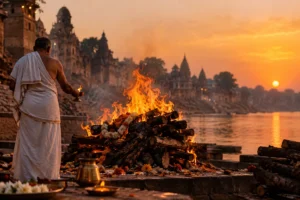
Upon arriving at the cremation ground, the body is placed on the funeral pyre or, in modern settings, prepared for cremation in a crematorium. The pyre is traditionally constructed of wood, with sandalwood being particularly auspicious due to its sacred properties and pleasant aroma.
The Cremation Ceremony
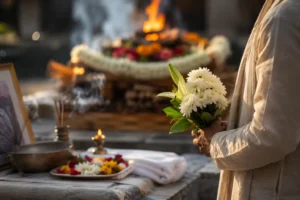
The cremation itself is the most critical aspect of the Hindu funeral. Fire (agni) holds profound significance in Hinduism, serving as both a purifying force and a divine messenger. The ceremony involves several prescribed rituals performed by the chief mourner under the guidance of a priest (pandit).
Before lighting the pyre, the chief mourner performs the ritual of Kapal Kriya or circumambulation. He walks around the pyre, typically three or seven times, carrying a clay pot filled with water. This pot has a hole that allows water to drip, creating a sacred boundary. After completing the circles, the pot is broken, symbolizing the breaking of earthly attachments.
The chief mourner then lights the funeral pyre, traditionally igniting the area near the deceased’s head for men or near the feet for women. This act, known as Mukhagni, is considered both a duty and a privilege. As flames consume the physical body, prayers and mantras are recited, including passages from the Vedas that speak of the soul’s immortality and its journey beyond the physical realm.
The cremation process can take several hours. Family members typically remain present, maintaining prayers and meditation. In traditional outdoor cremations, the chief mourner may perform the ritual of cracking the skull (Kapala Kriya) to release the soul, though this practice varies by region and is not performed in modern crematoriums.
Collection of Sacred Remains
After cremation, the ashes (asthi) are collected, traditionally on the third day following death, though modern practices may vary. The remains are carefully gathered and placed in an urn or cloth. These ashes are considered sacred and must be handled with utmost respect.
The immersion of ashes in holy waters, particularly the Ganges River, is a deeply significant ritual. Families often travel to sacred rivers, with Varanasi, Haridwar, and Allahabad being particularly revered destinations. The belief holds that immersion in these holy waters helps the soul achieve moksha or favorable rebirth. For those unable to travel to India, local rivers or the sea may be used, and some temples offer services to transport ashes to sacred sites.
During the immersion, prayers are offered for the peace and liberation of the departed soul. Flowers, often marigolds, are scattered in the water along with the ashes. This final act of releasing the physical remains symbolizes the complete letting go of the deceased’s earthly form.
The Mourning Period
Following the cremation, the family enters a thirteen-day mourning period called Sutaka or Ashaucha, meaning a period of ritual impurity. During this time, the family observes various restrictions and engages in specific rituals to support the soul’s transition.
The immediate family typically remains at home, receiving visitors who come to offer support and condolences. They follow a simple vegetarian diet, avoiding celebrations, temple visits, and social gatherings. White clothing continues to be worn as a symbol of mourning and detachment from worldly pleasures.
Daily rituals called Shraddha are performed, offering food, water, and prayers to the departed soul. These offerings, known as pinda-daan, are believed to nourish the soul during its journey between worlds. Rice balls mixed with sesame seeds and milk are traditionally offered, with the belief that the soul assumes a transitional body (Preta) that requires sustenance.
On the eleventh or thirteenth day, depending on regional customs, a significant ceremony marks the end of the primary mourning period. The Sapindikarana ritual transforms the departed soul from its transitional Preta state to join the ancestors (Pitrs). A feast is often held where community members are fed as an act of merit for the deceased.
Beyond Thirteen Days: Continuing Remembrance
Hindu tradition doesn’t end remembrance after the initial mourning period. Annual death anniversaries, called Shraddha or Tithi, are observed where family members perform rituals, offer prayers, and sometimes feed Brahmins or the needy as acts of merit for the departed soul.
Additionally, during Pitru Paksha, a sixteen-day period in the Hindu lunar calendar, Hindus perform rituals to honor all ancestors. These practices reflect the belief that the living and the dead remain connected, with the living having responsibilities toward their ancestors’ spiritual wellbeing.
Compassionate Support for Hindu Funeral Traditions
Hindu funeral rites are rich with meaning, symbolism, and spiritual significance, guiding both the departed soul and the grieving family through one of life’s most profound transitions.
Gooding Funeral Services brings cultural sensitivity and genuine understanding to Hindu funeral arrangements in Leeds and across West Yorkshire. As an independent, family-owned funeral director recommended by the Good Funeral Guide and the Natural Death Centre, we recognise that every detail matters, from ensuring cremation occurs within the traditional timeframe to providing appropriate facilities for ritual preparations.
Our on-site care facility treats your loved one with the dignity and respect they deserve, while our round-the-clock availability means support is always there when you need it, any time of day or night. With transparent pricing and no hidden costs, we help families honor their traditions within their means. When you need someone who truly understands the sacred importance of Hindu last rites, Gooding Funeral Services in uk is here to guide you with compassion, respect, and expertise. We’re just a call away.
Read more from our guide.