“Just as a person puts on new garments, giving up old ones, the soul similarly accepts new material bodies, giving up the old and useless ones.” — Bhagavad Gita 2.22
Hinduism, one of the world’s oldest living religions, teaches that death is not an end but a transition. The soul moves on, shaped by the life it has lived and the choices it has made. To understand what Hindus believe happens after death, four core concepts are essential — the eternal soul (Atman), the law of karma, the cycle of rebirth (Samsara), and ultimate liberation (Moksha).
The Atman: The Eternal Soul
At the heart of Hindu belief is the Atman, the individual soul. It is eternal, indestructible, and separate from the body, mind, or personality of any single lifetime. When the body dies, the Atman does not.
The Bhagavad Gita states it plainly: “The soul is never born nor dies at any time. It is unborn, eternal, ever-existing, and primeval. It is not slain when the body is slain.”
Grief is real and acknowledged in Hinduism, but it is held alongside the understanding that what was truly you cannot perish. The body is shed like worn clothing. The soul moves on.
Karma: The Law of Cause and Effect
Karma, from the Sanskrit word for “action,” describes the universal law of cause and effect that governs the soul’s journey across lifetimes. Every thought, word, and deed leaves an imprint that shapes future circumstances. There are four types of karma that Hindus recognise:
- Sanchita karma — the total accumulated karma from all past lives
- Prarabdha karma — the portion of that karma playing out in the current life, shaping birth, family, and major life events
- Kriyamana karma — the karma being generated right now through present choices
- Agami karma — future consequences of present actions, seeds planted today that will flower in lifetimes ahead
Karma is not punishment delivered by an external judge. It is simply the natural consequence of one’s choices, as consistent and impartial as gravity.
Samsara: The Cycle of Rebirth
Driven by karma and accumulated desires, the Atman enters a continuous cycle of birth, death, and rebirth known as Samsara. This is not punishment but a natural process, the soul taking on bodies as needed to work through karma and grow spiritually.
After death, most Hindu traditions hold that the soul passes through an intermediate state. Some traditions describe temporary realms of joy (Svarga) or purification (Naraka), though these are way stations rather than permanent destinations.
The soul’s next birth is shaped by its karma and its deepest attachments at the moment of death, which is why the spiritual environment surrounding a dying person matters so much. Sacred mantras are chanted, scripture is recited, and holy water from the Ganges may be offered to help orient the departing soul.
Hindu Funeral Rites
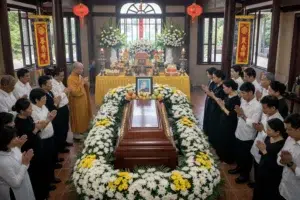
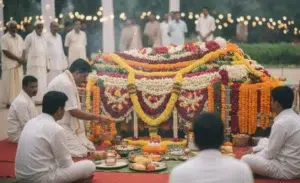
Hindu funeral rites, known as Antyesti or “last sacrifice,” are designed not just to honour the deceased but to actively support the soul’s onward journey. Key practices include:
- Cremation within 24 hours — fire is seen as purifying, returning the body to nature and releasing the soul from attachment to its previous form
- Varanasi — dying or being cremated in this sacred city on the Ganges is considered the most auspicious of all, believed to grant the soul liberation
- A 13-day mourning period — during which Shraddha rituals are performed, including offerings of rice balls (pinda) to nourish the soul in its transition
- Pitru Paksha — an annual 16-day period dedicated to honouring all departed ancestors through prayer and offering
Moksha: The Ultimate Liberation
Moksha, meaning liberation or release, is the ultimate goal of human existence in Hindu thought. It is the soul’s final awakening to its true nature and its permanent freedom from the cycle of rebirth.
Different philosophical schools within Hinduism describe Moksha in different ways. Advaita Vedanta teaches that Moksha is the realisation that the individual soul and universal consciousness (Brahman) are identical — there was never any real separation.
Dvaita Vedanta describes it as eternal loving union with a personal God. What all schools agree on is that Moksha brings an end to suffering and an experience of boundless peace and joy.
The four paths Hindus may follow to reach Moksha are:
- Jnana Yoga — the path of knowledge and philosophical inquiry
- Bhakti Yoga — the path of devotion, prayer, and love for God
- Karma Yoga — the path of selfless action and service without attachment to results
- Raja Yoga — the path of meditation and mental discipline
Each path, followed sincerely, is held to lead to the same destination.
Conclusion
The Hindu understanding of death is not abstract theology. It is woven into daily life, into the rituals surrounding a dying relative, the annual prayers for ancestors, and the quiet belief that how one lives now shapes the journey ahead. Death, in this view, is simply the soul stepping through a doorway.
If you are arranging a Hindu funeral services for loved one in the UK and want guidance that respects these traditions, Gooding is here to help. Our compassionate team supports Hindu families through every step of the process, from cremation arrangements to understanding the rites and timing that matter most. Reach out today to arrange a farewell that honours your loved one with the care and dignity they deserve.
Read more from our guide on funeral services in the UK.
Pages You Might Like:
Funeral directors UK, Funeral services UK, Funeral Services in Leeds, Funeral directors Leeds, Funeral Directors in Bradford, Funeral Directors Bradford, Funeral Directors Manchester, Funeral Directors Huddersfield, Funeral Services in Doncaster, Asian Funeral Services, Hindu Funeral Services, Sikh Funeral Services, Caribbean Funeral Service