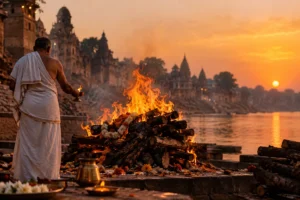
For Hindu and Sikh communities in the United Kingdom, the scattering of a loved one’s ashes in flowing water is not a personal preference. It is a religious duty.
Yet many families approach this final rite with uncertainty, unsure of what the law permits, what guidance they must follow, and whether the rivers of Britain can properly hold the spiritual weight of a ceremony rooted in the sacred waters of the Ganges or the Sutlej.
This guide sets out exactly what UK law says, what the Environment Agency requires, and where families can go to carry out this ceremony with dignity and confidence.
The Religious Significance of Ash Scattering in Hinduism and Sikhism
In Hinduism, cremation is not simply the preferred method of disposition. It is a religious obligation for most adult Hindus, rooted in the understanding that fire releases the soul from its attachment to the physical body and enables its progress toward liberation. The ceremony of Asthi Visarjan, the immersion of ashes in sacred water, completes this release. The Ganges at Varanasi, Haridwar, or Rishikesh is the ideal destination, but Hindu teaching broadly permits any flowing body of water when travel to India is not possible. For families seeking guidance on the full range of Hindu funeral services available in the UK, Gooding Funeral Services offers comprehensive support including ceremonial preparation and Pandit coordination.
In Sikhism, while the faith does not prescribe a single sacred site, cremation is the customary practice and the scattering of ashes in flowing water is widely observed. The sacred site of Kiratpur Sahib in Punjab holds particular significance for many Sikh families, as it was associated with the Sikh Gurus. Where travel to Punjab is not possible, Sikh teachings broadly support the use of any moving body of water. Families seeking support with Sikh funeral services in the UK can speak to Gooding Funeral Services, who have deep familiarity with Antam Sanskar rites and Gurdwara coordination.
The UK’s Hindu and Sikh populations together exceed 800,000 people. In recent years, and particularly since the travel disruptions of the pandemic, a growing number of families have chosen to carry out ash scattering ceremonies on British rivers, with the Thames, Soar, Avon, Severn, and Wye becoming the most frequently used sites.
What UK Law Actually Says
The position under UK law is clear and relatively permissive. There is no legislation that specifically prohibits the scattering of cremated ashes in rivers, lakes, or canals. The Cremation Act 1902 and subsequent cremation regulations govern the process of cremation itself but say nothing about where ashes may subsequently be scattered. The Human Tissue Act 2004 does not apply to cremated remains.
This position has been confirmed by the Law Society, which has advised that it is permissible to scatter ashes in rivers, streams, and lakes without requiring any licence or formal permission. The key point is that no permit is required for water-based scattering. Families do not need to apply to a government body, seek a court order, or obtain written authorisation from any authority before proceeding.
The absence of a specific legal prohibition, however, does not mean there are no rules to follow. The Environment Agency provides guidance designed to protect waterways and other users, and this guidance should be followed even though compliance is not strictly enforced through criminal sanction in most circumstances.
Environment Agency Guidelines for Scattering Ashes on Water
The Environment Agency (EA) is the regulatory body responsible for protecting rivers, lakes, and other inland waterways in England. The EA has stated explicitly that it has no evidence to suggest that the disposal of human ashes in rivers and streams has a negative impact on water quality or the environment. Its guidance is not a set of legal restrictions but a framework for responsible practice.
The key points from EA guidance are:
- No licence or permit is needed to scatter ashes in a river, lake, or canal.
- The scattering site should not be near any buildings, marinas, or areas where people are bathing or fishing.
- The site should be more than one kilometre upstream of any water abstraction point, such as a reservoir intake or water treatment works. Families can check this by contacting their local EA office.
- Ashes should be scattered as close to the surface of the water as possible, and families should avoid windy conditions to prevent ashes affecting people nearby.
- No other items should be placed in the water alongside the ashes. Wreaths, personal items, plastic flowers, and decorations must not be cast into the river, as these can harm wildlife and cause litter.
- Biodegradable urns or scatter tubes are recommended if the ashes are being released from a container rather than scattered directly.
The Canal & River Trust, which manages more than 2,000 miles of inland waterways in England and Wales, has similarly confirmed that it does not require formal permission for scattering ashes on its canals and navigations, provided the same environmental principles are followed.
Dedicated Sites for Hindu and Sikh Ash Scattering in the UK
In recognition of the growing demand for accessible and dignified water-based ceremonies, several local authorities and organisations across the UK have created or approved dedicated sites for the scattering of ashes, with the needs of Hindu and Sikh communities specifically in mind.
Leicester City Council has established a designated ash scattering platform on the River Soar, adjacent to the National Space Centre. The site was developed in direct partnership with Leicester’s Hindu and Sikh communities and is available free of charge. It provides a calm, accessible location with environmental safeguards built in.
In Scotland, Inverclyde Council was the first Scottish authority to make formal provision for this practice, designating a site on the River Clyde at the Newark slipway in Port Glasgow. This was done in explicit recognition of the faith needs of the local Hindu and Sikh community.
In Wales, Cardiff Council set aside a dedicated area on the River Taff at Llandaff Rowing Club, the first purpose-designated site in Wales. It was created in collaboration with the city’s Hindu and Sikh communities and is designed to allow ceremonies to take place in a setting that is both spiritually appropriate and environmentally protected.
On the River Thames, families can scatter ashes in various locations without permission, and a number of boat hire operators in London and along the river offer dedicated services for Hindu and Sikh families, providing a respectful setting and experienced crew who understand the significance of the ceremony.
Practical Guidance for Families Planning a Water Ceremony
Whether a family is planning a ceremony on the Thames, the Soar, or a local river in West Yorkshire, there are a number of practical steps that help ensure the ceremony proceeds smoothly. For Asian funeral services that include coordination of ash scattering arrangements, Gooding Funeral Services can advise families on local options and help with the wider logistics of the ceremony.
- Choose a quiet, accessible stretch of river away from boat traffic, anglers, and populated areas.
- Check the distance from any water abstraction point. If in doubt, call the Environment Agency on 03708 506 506 or contact your local EA office.
- Use a biodegradable scatter tube or water-soluble urn if ashes are being released from a container. Avoid any packaging that is plastic, metallic, or non-biodegradable.
- Do not place flowers, wreaths, garlands, or other tributes in the water. These can be held by mourners or placed at the riverbank without entering the water.
- Consider the weather. Windy conditions can make the ceremony difficult and may cause ashes to drift toward bystanders or residential areas. Calm days make for a more dignified and controlled ceremony.
- If using a boat service, confirm in advance that the operator is experienced with faith-based ceremonies and understands the specific requirements of Hindu Asthi Visarjan or Sikh ash scattering rites.
- Families wishing to take ashes to India or another country for scattering should carry a certified copy of the death certificate and the cremation certificate. Airlines and embassies may have additional requirements, so checking in advance is essential.
Are There Any Restrictions That Apply Specifically to Hindus and Sikhs?
No. UK law does not impose any faith-specific restrictions on ash scattering. The same Environment Agency guidance applies equally to all communities, regardless of religion or cultural background. There is no requirement for a Hindu or Sikh family to seek special permission that a non-religious family would not also need, and no authority has the power under current law to prevent a family from carrying out this rite in a suitable river location.
Some rivers or stretches of river fall within the ownership of private landowners or are managed by third parties such as fishing clubs or port authorities. In these cases, the EA guidance still applies but the family would benefit from informing the relevant manager in advance, as a courtesy and to ensure the site is unoccupied on the day of the ceremony.
Local bylaws can occasionally restrict access to specific riverbanks or bridge areas, particularly in urban centres. These relate to access to the land, not to the practice of scattering ashes itself. Where access is restricted, moving to a nearby stretch of the same river will usually resolve the issue without compromising the ceremony.
What About Scattering Ashes at Sea?
For families who prefer a maritime setting, UK law is equally permissive for the scattering of ashes at sea. No licence is required. The Marine Management Organisation governs full body burials at sea, which is a separate and more regulated process, but the scattering of cremated remains on tidal waters or at sea is subject only to the same environmental guidance that applies to rivers.
Many Hindu and Sikh families in coastal cities choose to charter a vessel and conduct the ceremony offshore. Boat operators in Brighton, Eastbourne, Portsmouth, and other coastal towns have developed considerable experience with faith-based ash scattering services and can accommodate the specific requirements of Asthi Visarjan or Sikh water rites.
Plan a Meaningful Ceremony With the Right Support
Scattering the ashes of a loved one in a flowing river is a profound and sacred act. UK law permits it, environmental guidance supports it, and local authorities across the country are increasingly making dedicated provision for it. Families should approach this final rite with confidence, knowing they are operating within the law and honouring a tradition that stretches back centuries.
Gooding Funeral Services has been supporting Hindu, Sikh, and wider Asian communities across West Yorkshire and the UK since 2007. Their culturally aware team understands the specific requirements of Antam Sanskar, Asthi Visarjan, and the full range of faith-based funeral and post-cremation rites. They are available 24 hours a day to guide families through every stage, from the first call to the final ceremony.
Frequently Asked Questions
Do Hindu and Sikh families need a permit to scatter ashes in a UK river?
No. There is no legal requirement for a permit or licence to scatter cremated ashes in a river, lake, or canal in the UK. The Environment Agency guidelines should be followed, but these do not require prior approval in most circumstances.
Can local councils prevent a family from scattering ashes in a river?
Local councils do not have the authority to prohibit ash scattering in rivers under current UK law. Councils can designate specific sites to facilitate the practice, as Leicester and Cardiff have done, but they cannot lawfully prevent families from choosing an appropriate riverside location that complies with EA guidance.
What items can be placed in the water alongside the ashes?
The Environment Agency guidance is clear that only the ashes themselves should enter the water. Wreaths, garlands, flowers, petals, personal items, and decorations should not be placed in the river, as they may contain plastic or metal parts that harm wildlife and cause litter. Biodegradable petals are acceptable in some locations if they disperse naturally, but it is safest to keep all tributes on the bank.
Which UK rivers are most commonly used for Hindu and Sikh ash scattering?
The Thames, Soar, Avon, Severn, and Wye are the most frequently used rivers. The River Soar in Leicester has a dedicated EA-approved platform. Many families also use local rivers wherever they are based, provided the EA guidance is followed.
Is it legal to scatter ashes in a river in Scotland and Wales?
Yes. The same general legal position applies across England, Scotland, and Wales: there is no legislation prohibiting the scattering of cremated ashes in rivers. In Scotland, the Scottish Environment Protection Agency (SEPA) provides the relevant environmental guidance. In Wales, Natural Resources Wales performs the equivalent role to the Environment Agency in England.
Can ashes be taken to India for scattering if the family prefers this?
Yes. Families who wish to take ashes to India or another country should carry a certified copy of the death certificate and cremation certificate. Airlines may have specific requirements regarding the packaging and documentation of cremated remains, so it is advisable to check with the carrier well in advance of travel.
Can a funeral director help with arranging an ash scattering ceremony?
Yes. An experienced funeral director with knowledge of Hindu and Sikh traditions can assist with identifying appropriate local sites, coordinating with boat operators if needed, and advising on the practical and ceremonial elements of the service. Gooding Funeral Services provides this support as part of their commitment to culturally informed funeral care.