There is a particular quality to grief in the former mining villages of Doncaster that outsiders rarely see. It is quiet but collective, undemonstrative but deeply felt, and rooted in a way of life that shaped everything from how men worked to how communities buried their dead. Places like Bentley, Rossington, Armthorpe, Edlington, Hatfield, and Woodlands were built around the collieries. The pit was the centre of economic and social gravity, and the bonds it forged above and below ground defined how people lived and, inevitably, how they said goodbye.
Understanding how these families approach funerals requires understanding the culture on which those communities were built. It is a culture of solidarity, practicality, and communal support that has evolved steadily since the last Doncaster pit closed at Hatfield in 2015, while retaining the character that generations of mining life produced.
The Mining Village as a Community Shaped by Shared Risk
The pit villages that grew up around Doncaster from the early twentieth century onward were unlike ordinary English villages. As historian Melvyn Jones documents in South Yorkshire Mining Villages, these were planned communities built to house a workforce, and they developed an unusually close-knit social fabric as a result. Brodsworth, Bentley, and Rossington were each laid out with workforces of around 3,000 men and projected outputs of one million tons of coal per year. Every family in the street often had a miner in the household, and many had lost one to the pit.
That shared exposure to danger created a culture where neighbours looked out for one another as a matter of routine. As scholars of South Yorkshire coalfield life have noted, relationships formed at work were reinforced in family, neighbourhood, and friendship networks in ways that did not exist in more economically diverse towns. When death came to one household, it was felt across the whole street. When a man was killed underground, the community gathered around his widow before any formal arrangements were made. This instinct did not disappear when the pits closed. It is still visible today in how Doncaster mining families handle bereavement.
Community Before Ceremony: The First Response to Death
In many English communities, the death of a neighbour prompts a card and perhaps a casserole dish left on the doorstep. In Doncaster’s former mining villages, the response has traditionally been more immediate and more physical. Neighbours arrive. Women from further along the street bring food. Men offer to handle practical tasks. This is not simply kindness; it is a reflex built into the culture over generations of coping with colliery accidents and industrial illness.
The tradition of laying out the body at home before any funeral director was involved was once standard across working-class Britain. In mining communities it persisted longer than elsewhere, sustained by the intimacy of terraced streets and the fact that many families knew the same people all their lives. While the practice of keeping the deceased at home has become less common in the twenty-first century, the social instinct behind it remains. Families in Rossington or Bentley will typically gather at the family home in the days following a death in a way that more closely resembles an informal wake than a series of private appointments. The door stays open. People come and go. Tea is made in large quantities.
The Miners’ Welfare and the Working Men’s Club
No account of social life in a Doncaster pit village is complete without acknowledging the Miners’ Welfare Institute. Funded through a levy on coal production, these organisations built community halls, recreation grounds, swimming pools, and social clubs across the coalfield. As the National Coal Mining Museum records, Welfare organisations supported everything from brass bands and sports clubs to education grants and rehabilitation for injured miners. They were the social infrastructure of pit village life.
The post-funeral gathering, or wake, has long been held in the local working men’s club or Miners’ Welfare Hall rather than in a private home. This reflects both the size of mining families and the genuine communal ownership of these spaces. When you grew up attending dances, meetings, and celebrations at the Welfare, it is natural that you would gather there to remember someone who did the same. Although many Welfare clubs across South Yorkshire have closed in recent decades, the ones that survive remain the preferred venue for the communal part of the farewell.
The pub, too, plays a role. Mining village pubs were never simply places to drink. They were extensions of the community hall, spaces for conversation, argument, and mutual support. Gathering for a drink in someone’s memory at the local is still a recognised part of the goodbye in many of these communities, separate from and usually following the formal wake.
Burial and Cremation in the Doncaster Coalfield
Like much of working-class northern England, Doncaster’s mining villages have largely followed the national shift toward cremation. In the UK overall, over 72 per cent of funerals now involve cremation, a figure that has risen steadily since the twentieth century.
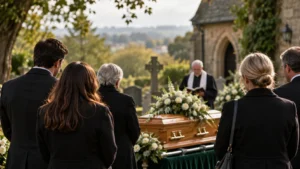
Burial remains a meaningful choice in many families, particularly where strong Catholic or Anglican traditions were kept alive through the pit village churches. The churches built alongside the colliery housing estates were not incidental. They were deliberate parts of the community plan, and generations of mining families baptised, married, and buried their dead through them. The parish churchyard in Rossington, Bentley, or Hatfield carries the names of entire family trees from the colliery era. For families with that connection, burial in the same ground as parents and grandparents carries a significance that no crematorium can replicate.
The Funeral Service: Practical, Honest, and Personal
Mining village funerals in Doncaster tend toward the direct rather than the elaborate. The tradition values honesty over ceremony and substance over show. A service that truly reflects the person who died matters far more than one that follows a prescribed format. Eulogies in these communities are often delivered by family members or close friends rather than clergy who may not have known the deceased, and they tend to be frank, funny, and full of specific detail. The humour is not disrespectful. It is how these communities have always processed difficulty.
Music plays a significant role. Hymns remain common in traditionally religious families, but popular songs, folk music, and recordings that held personal meaning for the deceased are now equally standard. In a region where brass bands were central to community life for over a century, it is not unusual for a Doncaster family to request that a traditional hymn or a favourite piece be played by a local band at the graveside or as the coffin is carried in. The connection between brass music and commemoration runs deep in South Yorkshire.
The dress code for these funerals is still predominantly black, particularly among older generations. The working-class tradition of buying a good dark suit and keeping it for funerals has not entirely disappeared, though younger family members now sometimes interpret the dress code more loosely, particularly at celebration-of-life ceremonies.
The Wake: Where the Real Goodbye Happens
If the service is the formal farewell, the wake is where it becomes real. As British funeral customs scholars have noted, the tradition of gathering after burial to share food and drink dates back to Anglo-Saxon times, when it served both practical and spiritual purposes. In mining communities the wake has always had a particular intensity. It is the moment when the formal structure of the service dissolves and people speak frankly about the person who has died, about their own grief, and about the shared history that connects them.
Food at a Doncaster mining family wake is typically homemade and substantial. Sandwiches, sausage rolls, pork pies, and baked goods prepared by women in the family and by neighbours form the spread. There is nothing performative about it. It is the same food that would have been laid out for a pit lodge meeting or a welfare dance half a century ago. Bringing food to a bereaved family remains one of the most instinctive expressions of support in these communities.
The gathering can last the afternoon and into the evening. Stories circulate. Photographs come out. People who have not seen each other in years reconnect. For older residents of places like Woodlands or Armthorpe, the wake serves as a reminder that the community still exists even after the industry that created it has gone.
How Traditions Are Changing
The pit closures that swept through Doncaster from the 1980s onward did not only end an industry. They changed the social fabric of these villages in ways that are still being felt. The Miners’ Welfare Institutes that anchored community life have closed one by one. Younger generations have moved away or lack the same depth of connection to the village as a fixed community. The funerals they plan reflect this.
Celebration-of-life ceremonies, which are less tied to religious liturgy and more focused on personal tribute, have grown in popularity. Direct cremation, followed by a memorial gathering at a later date, is increasingly chosen by families who want to take time before the formal ceremony. Personalised coffins, charitable donations in lieu of flowers, and the live streaming of services for family members who cannot travel are all features of contemporary Doncaster funerals that would have been unfamiliar a generation ago.
Yet the underlying values remain. The emphasis on community, on practical support for the bereaved family, on honest and personal tribute rather than formal ceremony, and on gathering together after the service still characterises how Doncaster mining families say goodbye. The form has changed more than the feeling.
Saying Goodbye With the Care These Communities Deserve
A good funeral for a Doncaster mining family is not necessarily an expensive one. It is one that reflects the person who died with honesty, that allows the community to gather and grieve together, and that handles every practical detail with the respect a life of hard work deserves. Finding the right funeral directors Doncaster to support that kind of farewell matters.
Gooding Funeral Services has a genuine understanding of the traditions and expectations of South Yorkshire families. Whether you are planning a traditional service with burial, a modern celebration of life, or need guidance on any aspect of a farewell that truly reflects your loved one, the team at Gooding Funeral Services is here to help. Reach out today for compassionate, experienced support in arranging a farewell worthy of the community values that matter most to your family.
Frequently Asked Questions
Q1. Do Doncaster mining families typically choose burial or cremation?
Both remain in use, but cremation is now the more common choice in line with national trends, which put UK cremation rates above 72 percent. Families with strong church ties, particularly Catholic or Anglican, more often choose burial, frequently in the same churchyard as previous generations.
Q2. Where are wakes typically held in Doncaster mining villages?
The local working men’s club or Miners’ Welfare Hall has traditionally been the preferred venue, where it still exists. Many families also use local pubs or community halls. Larger gatherings may be held in a local function room. The family home can still be the setting for smaller, closer gatherings.
Q3. Is brass band music still part of mining community funerals?
For some families with a deep connection to colliery band traditions, yes. South Yorkshire has a proud brass band heritage, and a number of active bands in the region are willing to play at funeral services or gravesides on request. It remains a meaningful choice for families wanting to honour the cultural heritage of the pit village.
Q4. How do these communities typically support a bereaved family before the funeral?
Practical, immediate support is the norm. Neighbours arrive, food is brought, and tasks are shared. This instinct for communal help was formed through generations of coping with colliery accidents and industrial illness and remains a recognisable feature of life in the former mining villages around Doncaster.
Q5. Are funerals in Doncaster mining communities religious or secular?
Both. Older generations are more likely to have a traditional church service, often Anglican or Catholic, reflecting the strong church presence in the original colliery villages. Younger families increasingly opt for secular or humanist ceremonies that focus on personal tribute. Many services blend elements of both.
Q6. What flowers are typically chosen for funerals in these communities?
Traditional arrangements of white lilies, chrysanthemums, and roses are the most common. Personal tributes shaped to reflect the deceased’s interests, such as a floral mining lamp or a Yorkshire rose design, have become increasingly popular. Charitable donations in lieu of flowers are also commonly requested, particularly for younger people.
Q7. How far in advance should a funeral be arranged in the Doncaster area?
Most funeral directors recommend contacting them as soon as possible after a death, ideally within the first day or two. The funeral itself typically takes place within ten to fourteen days, though this can vary depending on coroner involvement, the family’s preferences, and crematorium or burial availability.