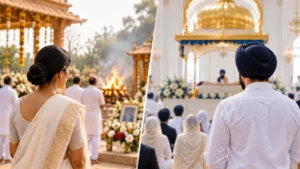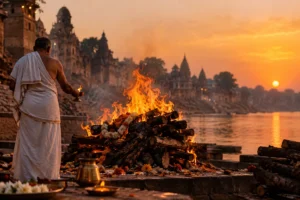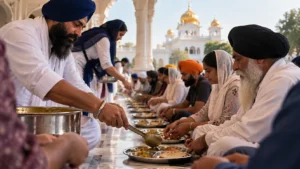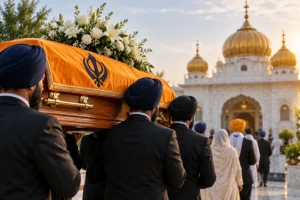
When a Sikh family loses a loved one, friends, colleagues, and neighbours often want to understand how to offer support in the right way. One question comes up again and again: is there a set 10-day mourning period in Sikhism, similar to the mourning periods observed in other faiths? The honest answer is more nuanced than a simple yes or no.
Sikhism does not prescribe a formal, obligatory mourning ritual, yet the ten days following a death do carry real significance, built around the completion of a sacred scripture reading rather than a fixed grieving custom. This guide walks through what actually happens in the days after a Sikh funeral, known as Antam Sanskar, and explains where the idea of a ten day period comes from.
What Sikhism Teaches About Death and Mourning
Sikh teachings regard death as a natural and inevitable stage of life, encouraging people to accept it with faith rather than fear. Death is understood as Hukam, the will of God, and the soul is believed to continue its journey toward union with Waheguru. For families arranging a Sikh funeral with experienced Funeral Directors in the UK, understanding these beliefs helps ensure services are conducted respectfully and in accordance with Sikh traditions.
Because of this belief, the Sikh Gurus specifically discouraged excessive or theatrical displays of grief. Loud wailing, breast beating, and prolonged public mourning are considered contrary to Sikh values, since they suggest resistance to God’s will rather than calm acceptance of it.
This does not mean sadness is denied or ignored. Sikhism recognises that losing someone hurts deeply, and it fully supports quiet, private grief alongside communal prayer and mutual comfort shared among family, friends, and the wider Sangat.
The Immediate Days After Death: Antam Sanskar
The Sikh funeral itself, called Antam Sanskar, meaning final rite of passage, tends to happen quickly after death. Tradition favours cremation within a few days, though in the UK this timeline is shaped by practical requirements such as death registration and crematorium availability, so a gap of three to seven days is common rather than the same day or next day cremation seen in India.
Two core prayers anchor the ceremony: the Ardas, a supplication recited at major life milestones such as birth, marriage, and death, and the Kirtan Sohila, which reminds mourners to accept death as an ultimate truth rather than something to fear. Before a UK funeral can proceed, the death must first be registered and the resulting certificate passed to the funeral director or crematorium, a process explained fully in the government’s guidance on registering a death.
The Reading of the Guru Granth Sahib
Once the cremation has taken place, the family begins a devotional reading of the entire Guru Granth Sahib, the Sikh holy scripture. This can happen in two ways. An Akhand Path is a continuous, unbroken reading carried out in relay by a team of readers, and it is usually completed within about 48 hours from start to finish.
A Sehaj Path, sometimes spelled Sahaj Path, is a non-continuous reading spread across a longer stretch of days, most commonly around ten days, depending on the family’s circumstances and how many readers are available. Either version can take place at the family home or at the Gurdwara, and both are understood as a way of drawing spiritual comfort and strength while honouring the soul of the person who has died.
Why Day Ten Matters: The Bhog Ceremony
The conclusion of the scripture reading is marked by the Bhog ceremony, and this is the real source of the ten day association many people ask about. When the final pages of the Guru Granth Sahib are read, usually on or around the tenth day after death, though sometimes as late as day thirteen depending on scheduling and family convenience, relatives, friends, and the wider community gather at the Gurdwara.
Musicians sing Shabad hymns, Saloks composed by Guru Tegh Bahadur are recited, and a Hukam, a randomly selected passage offering divine guidance, is read aloud to the congregation. Karah Parshad, a warm sweet sacred food, is distributed to everyone present, and a communal Langar meal typically follows. In some families, the Bhog ceremony also includes the tying of a turban on the eldest male relative, symbolically marking the transition of responsibility to a new head of the household.
So, Is There Really a Ten Day Mourning Period?
Strictly speaking, Sikhism does not mandate a fixed mourning period in the way some other traditions prescribe a set number of days of ritual observance. This is different from Hindu mourning customs, where a defined period leading up to a specific closing ceremony is more clearly laid out. What exists in Sikh practice instead is a practical rhythm: the scripture reading typically wraps up around the tenth day, and the Bhog ceremony that follows functions as a natural close to the most intensive phase of communal mourning.
After Bhog, families are generally expected to resume ordinary life, since Sikh teaching holds that prolonged sorrow can hinder spiritual progress rather than support it. That said, many sources describe this window loosely as a ten day mourning period simply because it is the most visible, structured stretch of time between the death and the community gathering that marks closure. Private grief, of course, continues well beyond any single ceremony, and Sikh families are free to observe quiet remembrance in whatever way feels right for them.
Regional and Family Variations
It is worth remembering that Antam Sanskar is not practised identically in every household. Some families complete the Sehaj Path in exactly ten days, others extend it slightly to accommodate work commitments, travel from abroad, or the availability of a Granthi to lead the readings. Diaspora families in the UK often adapt timings around crematorium bookings and weekend availability at the local Gurdwara, since readings are easier to organise when relatives can attend outside working hours.
None of this is considered a departure from proper practice. Sikh teaching places the emphasis on sincerity of devotion rather than rigid adherence to a calendar, so a family that finishes its reading on day nine or day twelve has not done anything wrong. This flexibility is one reason the ten day figure should be understood as a common pattern rather than a strict religious rule.
Supporting a Sikh Family During These Days
If you are attending a Sikh funeral or supporting a bereaved family through the days leading up to Bhog, a few points of etiquette can help you offer the right kind of support.
- Wear modest, light coloured clothing and cover your head with a scarf or turban when visiting the Gurdwara.
- Remove your shoes before entering the Gurdwara or a family home that is hosting prayers.
- Avoid asking detailed questions about mourning rules, since Sikh families are not bound by a strict ritual calendar.
- Offer practical help such as meals, childcare, or transport rather than expecting to attend every prayer session.
- Refrain from sending funeral flowers unless the family has confirmed this would be welcome.
- Keep condolence visits brief and centred on quiet support rather than prolonged conversation or questions.
- Respect that public displays of grief are generally discouraged within Sikh custom and everyday etiquette.
Practical and Legal Matters During the Mourning Period
While a Sikh family focuses on prayer, scripture, and remembrance, several administrative steps usually need attention in the background during those same ten days. In England and Wales, the death must be registered before a funeral can proceed, and the government’s guidance on registering a death explains the documents and timelines involved, including the free Tell Us Once service that notifies multiple public bodies about a death in one single go.
Families who are arranging the funeral themselves, or working alongside an independent funeral director, can find a full breakdown of the process on the government’s dedicated page for arranging a funeral. Employers are not always required to provide paid bereavement leave outside a small number of specific circumstances, so it is worth checking current entitlements through Acas guidance on time off for bereavement, particularly if the ten days of prayer and the Bhog ceremony happen to fall during a working week.
Conclusion
The days following a Sikh funeral are shaped less by a rigid mourning period and more by devotion, scripture, and community support, culminating in the Bhog ceremony around the tenth day after death. Understanding this rhythm helps families, friends, and employers offer the right kind of support at the right time, without imposing assumptions borrowed from other traditions.
If you are arranging a funeral for a loved one and want experienced, culturally informed guidance through Antam Sanskar, Gurdwara coordination, and every practical detail in between, the team at Gooding Funeral Services is available 24/7 to help. Visit our dedicated Sikh funeral services page to learn more, explore our prepaid funeral plans to plan ahead with confidence, or contact us today to speak with a funeral director who understands Sikh customs and can guide your family with genuine care.
Frequently Asked Questions
- Is there an official ten day mourning period in Sikhism?
Not in the sense of a mandated ritual. Sikhism discourages prolonged mourning, but the reading of the Guru Granth Sahib typically finishes around the tenth day, and the Bhog ceremony that follows is often described informally as marking the end of a ten day mourning period.
- What happens on the tenth day after a Sikh death?
The tenth day usually marks the completion of the Sehaj Path scripture reading, celebrated with the Bhog ceremony, which includes hymn singing, a Hukam reading, Karah Parshad, and a communal Langar meal.
- How long does Sikh mourning actually last?
The structured, communal phase generally lasts up to ten days, sometimes extending to day thirteen depending on scheduling, though private grief and remembrance can continue for as long as the family needs.
- Can the scripture reading finish before or after ten days?
Yes. An Akhand Path, the continuous reading, is usually completed within about 48 hours, while a Sehaj Path can be extended beyond ten days if that better suits the family’s circumstances.
- What is the Bhog ceremony?
Bhog is the concluding ceremony of the Guru Granth Sahib reading, marking the formal close of the mourning period with prayers, a Hukam reading, and shared food among the community.
- Do Sikhs wear black to show mourning?
No. White or light, modest clothing is traditional for Sikh funerals and mourning, while black is generally associated with Western funeral customs rather than Sikh practice.