India is home to two of the world’s most spiritually rich funeral traditions. Sikh and Hindu families both turn to cremation, prayer, and community support when a loved one passes away, yet the meaning behind each ritual comes from a very different philosophical root. Families looking for experienced Funeral directors in the UK can benefit from choosing a provider familiar with Sikh and Hindu funeral traditions.
This guide walks through the core beliefs, rituals, timelines, and mourning practices of both traditions, and highlights where they overlap and where they part ways.
Funeral Trends in the UK
Every year, thousands of Sikh and Hindu families across the UK arrange funerals that honour their religious beliefs while complying with local regulations. According to the UK’s Cremation Society, more than 79% of funerals in the UK now result in cremation, making it the most common funeral choice nationwide. This aligns closely with both Sikh and Hindu traditions, where cremation is the preferred method of laying a loved one to rest.
For families arranging services in cities such as London, Birmingham, Leicester, or Bradford, understanding both religious customs and UK funeral procedures helps ensure ceremonies are conducted respectfully and without unnecessary delays.
Understanding the Core Beliefs
Both religions view death as a transition rather than an end, but the destination of the soul is described differently.
In Sikhism, Antam Sanskar or the final rites reflect the belief that death is God’s will, known as Hukam. The soul is on a journey back to Waheguru, and the funeral is treated less as a moment of grief and more as an acceptance of divine timing.
Hindu funeral rites, called Antyesti, follow the framework laid out in texts like the Garuda Purana. The soul is guided through an intermediate stage toward the ancestral realm, Pitru Loka, or ultimate liberation, Moksha. Rebirth and karma play a central role in how rituals are timed and performed.
- Sikhism emphasizes calm acceptance over visible mourning
- Hinduism structures grief through a defined thirteen day process
- Both faiths see the body as a temporary shell for the soul
- Neither tradition encourages permanent monuments at the pyre site
The Funeral Process Compared
In the UK, Cremation is the preferred method of disposal in both communities, and the sequence of events looks similar on the surface. Looking closer reveals different priorities.
Sikh Funeral Process
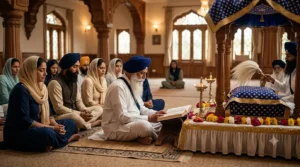
A Sikh funeral typically has three components: preparation and cremation, a gurdwara ceremony, and the scattering of ashes.
- The body is washed and dressed in fresh clothing before cremation
- Baptised Sikhs are dressed with the five sacred articles of faith
- Hymns called Shabads are recited from the Guru Granth Sahib
- The Ardas prayer marks the opening and closing of the service
- Kirtan Sohila is recited as the closing evening prayer
- The eldest son or a close relative usually lights the pyre
- Ashes are collected and immersed in flowing water afterward
Following cremation, families often undertake a reading of the entire Guru Granth Sahib known as Sahaj Paath, completed within ten days and concluded with a Bhog ceremony that formally closes the mourning period.
If you’re arranging a Sikh ceremony, our guide to Sikh Funeral Services explains each stage of the process in greater detail.
Hindu Funeral Process
Hindu last rites follow a longer and more elaborate sequence rooted in Vedic scripture.
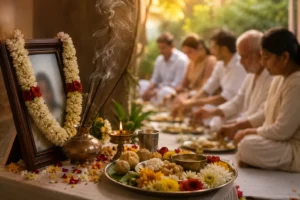
- The body is bathed, dressed in white or saffron, and adorned with flowers
- Sacred ash or sandalwood paste is applied to the forehead
- The body is placed with the head pointing toward the south
- A priest recites mantras from the Garuda Purana during the rites
- The eldest son typically lights the funeral pyre as chief mourner
- Kapal Kriya, the ritual breaking of the skull, releases the soul
- Ashes are collected on the third day and immersed in a river
The period that follows, known as Sutak or Ashaucha, is a window of ritual impurity where the family avoids temples and festive activity. Daily Pinda and Tarpan offerings are made to sustain the departed soul on its journey.
Families wanting more detailed guidance can also read our dedicated guide to Hindu Funeral Services and how ceremonies are arranged throughout the UK.
Mourning Period and Timeline
This is where the two traditions diverge most clearly.
Sikh mourning is intentionally brief and restrained. The Bhog ceremony usually concludes within ten days, and the community is encouraged to maintain Chardi Kalaa, a state of high spirits and faith, rather than prolonged grief.
Hindu mourning follows a structured thirteen day cycle, moving through the Chautha on the fourth day and closing with the Terahvi or Shraddha ceremony on the thirteenth day. Many families also observe an annual Shraddha during Pitru Paksha to continue honoring ancestors.
- Sikh mourning closes within roughly ten days after death
- Hindu mourning extends through a formal thirteen day cycle
- Hindu families may repeat rites annually during Pitru Paksha
- Sikh tradition discourages loud wailing or extended grief displays
Prayers, Scripture, and Symbolism
The spiritual centerpiece differs sharply between the two faiths.
- Sikh funerals center on Ardas, Kirtan Sohila, and Shabad recitation
- Hindu funerals draw heavily from the Garuda Purana and Bhagavad Gita
- Sikh scripture reading is the Guru Granth Sahib, never taken to the pyre
- Hindu priests guide most rites, while Sikh ceremonies are congregational
Sikhism does not use astrology, superstition, or elaborate ritualism in its funeral customs, keeping the service simple and community focused. Hindu rites are highly structured around scriptural timing, priestly guidance, and regional variation, with North and South Indian communities following somewhat different sequences of offerings.
Clothing, Flowers, and Etiquette
- Sikhs traditionally favor white clothing at funeral gatherings
- Hindus dress the deceased in white for elders and widows
- Married Hindu women may be dressed in red or yellow instead
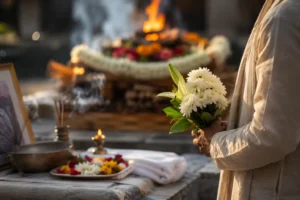
- Orange and white chrysanthemums are common mourning flowers
- Flowers and gifts are discouraged at most Sikh funeral services
Visitors to either ceremony are generally expected to dress modestly, cover their heads inside a gurdwara or during Hindu prayer readings, and follow the lead of family members regarding when to sit, stand, or approach the deceased.
Key Similarities at a Glance
- Both traditions strongly prefer cremation over burial
- Both view the body as separate from the eternal soul
- Both discourage permanent monuments or elaborate gravestones
- Both immerse ashes in flowing water such as a river
- Both rely on community support to carry the family through loss
Key Differences at a Glance
- Sikh mourning lasts about ten days, Hindu mourning about thirteen
- Sikh services avoid priest led ritualism in favor of congregation prayer
- Sikh belief centers on Waheguru, Hindu belief centers on karma and rebirth
- Hindu families observe annual Shraddha, a practice absent in Sikh custom
Regional Variations Worth Knowing
Neither tradition is entirely uniform across India, and small regional differences often surprise families attending a funeral outside their home state.
- South Indian Hindu rites often include Tila Tarpana with sesame seeds
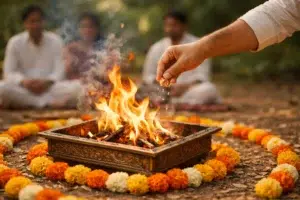
- North Indian Hindu funerals commonly feature a havan fire ceremony
- Punjabi Sikh communities may extend the Akhand Path over three days
- Diaspora Sikh funerals sometimes adopt Western dress conventions like black attire
These regional adaptations do not change the underlying theology, but they do affect how a service looks and how long it takes. Families coordinating a funeral across different branches of a household often need to reconcile these local customs in advance.
Families based in West Yorkshire often seek experienced Funeral directors in Bradford who understand both local crematorium procedures and religious customs.
Why These Details Matter During Repatriation
Families living abroad often face an added layer of complexity when a loved one passes away far from home. Coordinating cremation, prayer timelines, documentation, and the eventual immersion of ashes in Indian rivers requires careful planning, especially when religious timing is important to the family. Getting the sequence right, from the initial rites to the final journey home, brings real comfort during a painful time.
International repatriation adds logistical steps that most families have never navigated before, including embalming regulations, airline documentation, customs clearance, and coordination with a receiving funeral home in India. Missing any one of these steps can delay rites that are meant to happen within a specific number of days after death, which is why working with an experienced repatriation partner matters as much as understanding the religious customs themselves.
Final Thoughts
Sikh and Hindu funeral traditions in the UK share a common thread of respect, cremation, and community support, but they express grief and spirituality through very different structures. Understanding these customs helps families honor their loved ones correctly and helps friends and colleagues offer support without missteps during a sensitive time.
If you are coordinating a funeral, repatriation, or the transport of a loved one’s remains across borders, professional guidance makes an emotional process considerably easier. Gooding Funeral Services specializes in respectful, culturally informed funeral support for Sikh and Hindu families. Reach out to our team to arrange a dignified journey for your loved one.
Read more from our Gooding Funeral Guide.
Frequently Asked Questions
- Do Sikhs and Hindus both practice cremation?
Yes. Both communities strongly prefer cremation, viewing it as a way to release the soul from the physical body. Burial is only used in exceptional cases such as infant deaths or specific spiritual roles.
- How long does Hindu mourning last compared to Sikh mourning?
Hindu mourning typically follows a structured thirteen day period ending with the Terahvi ceremony. Sikh mourning is generally shorter, concluding with the Bhog ceremony within about ten days of the passing.
- Can non-Sikhs or non-Hindus attend these funerals?
Yes, both traditions welcome respectful guests from any background. Visitors should dress modestly, follow head covering customs where required, and take cues from the family on etiquette.
- Are monuments or gravestones allowed in either tradition?
No. Neither Sikhism nor mainstream Hindu practice encourages permanent monuments at the cremation site, since both view the body as a temporary vessel rather than a lasting memorial.
- What happens to the ashes after cremation?
In both traditions, ashes are collected after cremation and immersed in flowing water, most commonly a river considered sacred, symbolizing the soul’s return to nature.
- What if the family cannot immerse ashes in India right away?
Many families arrange for careful transport and repatriation of ashes or remains to complete rites at a sacred site in India when the death occurs abroad, coordinating with funeral professionals who understand the required documentation and timing.