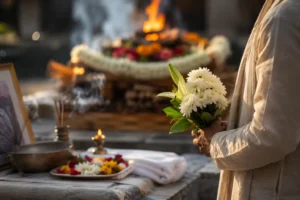
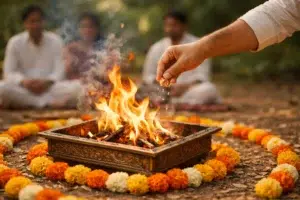
Cremation sits at the very centre of Hindu funeral practice, not as a matter of preference but as a spiritual necessity rooted in beliefs about the soul, the body and the journey that follows death. For Hindu families in the UK, this conviction meets a legal and practical landscape shaped by British cremation law, and understanding how the two fit together makes a genuinely difficult time considerably easier to navigate. This guide explains the beliefs behind Hindu cremation, walks through the rituals themselves, and sets out exactly how UK practice accommodates them, with input from experienced funeral directors in UK who support Hindu families through this process regularly.
Why Hindus Cremate Rather Than Bury
Cremation, known in Hindu tradition as antyesti or the last sacrifice, is the overwhelmingly preferred funeral rite across almost all branches of Hinduism. The underlying belief holds that the body is a temporary vessel for the soul, or atman, and that the soul is eternal, passing through repeated cycles of birth, death and rebirth known as samsara. Fire, in this understanding, is not destructive but transformative, releasing the soul from its physical form so it can continue its journey toward moksha, liberation from the endless cycle of rebirth.
Hindu philosophy also frames the human body as composed of five elements, earth, water, fire, air and space, and cremation is understood as returning the body to these origins in the most direct and symbolically complete way available. Burial, by contrast, is traditionally reserved in Hindu practice for specific exceptions, such as very young children or certain renunciate holy figures, rather than treated as an equally valid alternative for the wider community.
The Antyesti Rituals: What Happens Before Cremation
Hindu funeral rites begin well before the body reaches a crematorium, with a structured sequence of home based rituals carried out by family and close community members.
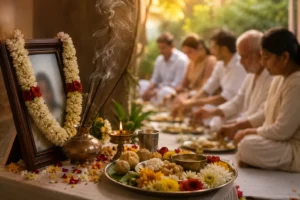
- The body is washed, anointed with oils or sandalwood paste, and dressed simply, usually in white cloth, shortly after death.
- Family and friends gather at the home to chant prayers and offer their final respects before the body is moved.
- Cremation traditionally takes place within twenty four hours of death, reflecting the belief that a swift release helps the soul continue its journey without unnecessary delay.
- The body is traditionally positioned with the feet facing south during the final rites, a direction associated in Hindu belief with Yama, the god of death.
In the UK, this rapid timeline often needs to adapt around medical examiner review, death registration and crematorium availability, and an experienced funeral director typically works to compress these steps wherever legally possible, while being honest with the family about which parts of the process cannot be rushed.
Mukhagni: The Central Cremation Ritual
The defining ritual of a Hindu cremation is mukhagni, the act of lighting the funeral pyre or, in modern UK crematoria, activating the cremation chamber, traditionally performed by the eldest son or closest male relative of the person who has died. A Hindu priest, or pandit, leads the ceremony alongside this act, reciting mantras and hymns drawn from the Vedas as the cremation proceeds.
While this role has historically been reserved for male relatives, many Hindu families in the UK today allow daughters, wives or other close female relatives to take part in mukhagni as well, reflecting a gradual evolution in practice that most priests and communities now accept without difficulty. The ceremony at a UK crematorium generally lasts around thirty minutes and includes prayers, readings and, in many cases, a period where mourners can walk past the coffin to pay their final respects.
Asthi Visarjan: Collecting and Immersing the Ashes
Once cremation is complete, Hindu tradition calls for the ashes, referred to as asthi, to be collected, typically a few days after the cremation itself, and eventually immersed in flowing water. This final step, known as asthi visarjan, is considered essential to completing the soul’s release, since water is regarded in Hindu belief as a purifying element that carries the remains onward and assists the soul’s progress toward moksha.
- The River Ganges, particularly at Varanasi, Haridwar or Prayagraj, is considered the most sacred destination for asthi visarjan in Hindu tradition.
- Many UK Hindu families travel to India personally to perform this immersion, sometimes weeks or months after the cremation itself.
- Postal and courier services offered by some UK temples and specialist organisations can arrange immersion in the Ganges on a family’s behalf.
- Families who cannot travel often choose a flowing UK river instead, such as the Thames, Mersey, Severn or Tyne, as an accepted alternative.
A short ceremony called Shraddha typically follows asthi visarjan, involving prayers and food offerings intended to support the soul’s continued journey and to honour the memory of the person who has died.
How UK Law Shapes Hindu Cremation Practice
British cremation law was not originally designed with Hindu ritual in mind, and this occasionally creates friction between religious expectation and legal requirement, most notably around the question of open air funeral pyres.
- The Cremation Act 1902 restricts cremation to a properly notified crematorium and makes it a criminal offence to burn human remains outside these provisions.
- Davender Ghai, a devout Hindu, spent several years challenging this restriction through the UK courts, arguing that open air cremation was essential to his beliefs.
- In 2010, the Court of Appeal ruled that a natural cremation could lawfully take place within a structure that had walls and a roof, even a partial one, satisfying the legal definition of a building.
- This ruling paved the way for facilities offering a more traditional style of cremation within a legally compliant structure, rather than a fully open air pyre on unenclosed land.
For the vast majority of Hindu families in the UK, cremation still takes place at a standard local crematorium, with the ritual and spiritual elements, mukhagni, mantras and the priest’s role, carried out fully within that setting despite the absence of an open flame pyre. The legal outcome of the Ghai case matters symbolically and for a small number of families seeking a more traditional format, even though most Hindu cremations in Britain proceed through conventional crematoria.
The UK Mourning Period and What Follows Cremation
After the cremation itself, Hindu families in the UK typically observe a mourning period lasting between ten and thirteen days, often marked by simple vegetarian meals, the avoidance of celebrations, and daily prayers at home. This period generally concludes with a ceremony that formally closes the intense phase of mourning, after which many families gradually return to ordinary routines, sometimes marking the first anniversary of the death with a further memorial gathering.
Families wanting to understand this period in more depth, including what guests should expect and how to offer support appropriately, can find further detail in our guide on Hindu Funeral Services, which covers the wider funeral process from first arrangements through to the closing rites.
Practical Guidance for Immersing Ashes in the UK
Families choosing to immerse ashes in a UK river rather than travelling to India should be aware of environmental guidance that applies regardless of religious intent. Under the Environment Agency’s guidance on scattering cremation ashes, ashes may generally be scattered or immersed in inland waters provided no urn, container or non-biodegradable material is left behind, and families are encouraged to check locally for any specific restrictions before proceeding. Checking this guidance in advance avoids any unintended difficulty during what should remain a purely spiritual and personal moment.
Arrange a Hindu Cremation With Confidence
Understanding the beliefs and rituals behind Hindu cremation helps families approach the process with clarity during an already difficult time, and knowing how UK law fits around these customs removes much of the uncertainty families often feel. Gooding Funeral Services provides experienced, culturally aware Hindu Funeral Services across the UK, coordinating closely with priests and families to honour every stage of antyesti correctly. Contact our team today to arrange a dignified, respectful cremation for your loved one.
Frequently Asked Questions
Why do Hindus cremate instead of bury their dead?
Hindus cremate because the body is considered a temporary vessel for an eternal soul, and fire is believed to release that soul from its physical form so it can continue its journey toward moksha, liberation from the cycle of rebirth.
What is mukhagni in a Hindu cremation?
Mukhagni is the ritual act of lighting the funeral pyre or activating the cremation chamber, traditionally performed by the eldest son or closest male relative, though many UK families now allow female relatives to take part as well.
Is open air cremation legal in the UK?
Open air cremation on entirely unenclosed land remains restricted under the Cremation Act 1902, though a 2010 Court of Appeal ruling confirmed that a natural style cremation within a structure with walls and a roof, even partial, can satisfy the legal definition of a building.
What happens to the ashes after a Hindu cremation?
Ashes are typically collected a few days after cremation and eventually immersed in flowing water, a ritual known as asthi visarjan, most traditionally performed in the River Ganges, though many UK families use a local flowing river or arrange immersion in India through a specialist service.
How long does Hindu mourning last after a cremation in the UK?
Most Hindu families observe a mourning period of around ten to thirteen days following the cremation, typically involving simple vegetarian meals, daily prayers and the avoidance of celebrations, concluding with a ceremony that formally closes this period.
Can ashes be scattered in any UK river?
Ashes can generally be scattered or immersed in inland UK waters provided no container or non-biodegradable material is left behind, though it is worth checking Environment Agency guidance and any local restrictions before proceeding.