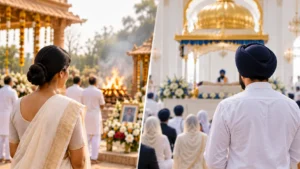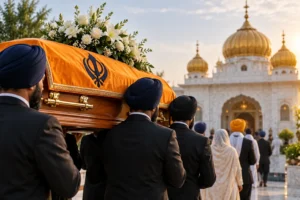
Few decisions weigh on a Hindu family as heavily as deciding who will carry their loved one for the last time. The question often arrives within hours of a death, at a moment when relatives are exhausted, unsure of the rules and worried about getting something wrong. The short answer is that Hindu tradition places this honour with close male relatives, led by the eldest son, though UK practice has become noticeably more flexible. This guide explains the tradition, the reasoning behind it, how modern families adapt it, and how experienced funeral directors in UK help families make the choice with confidence.
The Short Answer
Traditionally, the pallbearers at a Hindu funeral are the deceased’s close male relatives, with the eldest son taking the lead. If there is no son, the nearest male relative, such as a brother, grandson, son-in-law or nephew, steps forward. In the UK today, many families include daughters, wives, sisters, and close friends among the bearers, and most Hindu priests accept this when it reflects the family’s wishes. There is no single rule that every family must follow, and the pandit’s guidance carries more weight than any general checklist.
What Carrying the Body Means in Hindu Tradition
In Hindu belief, carrying the deceased is a sacred duty rather than a purely practical task. The Hindi phrase kandha dena, giving the shoulder, expresses it well. It is regarded as one of the final acts of service a family can offer, and carrying the body is understood as a way of repaying the love and care received during life. In India, relatives traditionally carry the body on a bier, called an arthi, from the home to the cremation ground, often chanting prayers or the name of God along the way.
Because the act carries such weight, who performs it matters spiritually as well as socially. Family honour, seniority and ritual responsibility all play a part, which explains why the choice can feel so loaded even for families who are not strictly observant.
The Traditional Order of Responsibility
Although details differ between regions, sects and families, the traditional order of preference follows closeness of kinship through the male line.
- The eldest son usually takes the leading role, carrying the front of the bier and performing the principal rites.
- Other sons, grandsons and brothers of the deceased are next in line to share the carrying.
- Sons in law, nephews and other close male relatives are traditionally invited when more bearers are needed.
- Close friends and members of the community may be asked to help when the family is small or geographically scattered.
The eldest son’s role also extends beyond carrying. He is traditionally the chief mourner who performs mukhagni, the lighting of the pyre, which in a UK crematorium is symbolised by pressing the cremator button or initiating the cremation. Our wider guide to Hindu Funeral Services explains how these rites fit together on the day.
Can Women Be Pallbearers at a Hindu Funeral?
Historically, women did not usually carry the bier or attend the cremation ground in many parts of India, partly for reasons of custom and partly because of the physical and emotional demands of the cremation itself. That picture has shifted considerably, particularly among British Hindu families, where daughters, wives and sisters increasingly take an active part in the funeral, including carrying the coffin and performing rites.
Most UK pandits accept this without objection, especially where there is no son or where female relatives were closest to the person who died. The sensible approach is to speak with your priest in advance, explain the family’s wishes and let them confirm how the ceremony will proceed. Families who raise it early rarely meet resistance.
How Coffin Bearing Works at a UK Crematorium
Britain’s funeral setting changes the practicalities in a few important ways. Hindu funerals in the UK usually go from the family home, or sometimes a funeral home, straight to the crematorium, rather than through a long procession on foot. The coffin travels in a hearse and is then carried into the chapel.
- Six bearers is the most common arrangement in the UK, although four or eight may be used depending on the coffin.
- Family members can carry the coffin from the hearse into the chapel, often with funeral director staff guiding or supporting.
- Many Hindu funerals use an open coffin, which funeral directors manage carefully so family only need to carry once it is secured.
- Some families prefer the funeral director’s trained bearers to carry the coffin, while relatives walk beside it in prayer.
Both approaches are acceptable. What matters is that the family feels the farewell was carried out with care, and a good funeral director will support whichever arrangement you choose rather than steering you toward one.
Practical Questions to Ask Before You Decide
Beyond tradition, a few practical considerations help families choose bearers who can do the job safely and calmly.
- Physical fitness matters, because a coffin with an adult inside is heavy, and a lift that goes wrong is dangerous and distressing.
- Height and build should be reasonably matched so the weight is shared evenly and the coffin stays level.
- Emotional readiness is just as important as strength, and anyone who feels unable to cope should be free to decline without any stigma.
- Steps, slopes and narrow doorways at the venue should be checked beforehand with the funeral director.
Elderly relatives or those with health conditions can still take part respectfully, for example by walking beside the coffin, touching it in prayer or placing flowers and offerings, without carrying the full weight.
When There Is No Son or Few Male Relatives
Many UK families face a smaller or more scattered extended family than their parents did, and a lack of male relatives is increasingly common. Modern Hindu practice and most priests accept a flexible approach in these cases.
- A daughter, wife or sister may take the chief mourner role and perform the principal rites.
- A close friend or community member can be invited to carry the coffin alongside available relatives.
- The funeral director’s team can carry the coffin while the family performs the ritual elements.
Families sometimes worry that these adaptations are somehow incomplete. In practice, priests focus on sincerity, correct mantras and the family’s participation, rather than on strict male only carrying.
The Role of the Pandit and the Funeral Director
The pandit confirms who should perform each ritual role and guides the sequence on the day, while the funeral director handles the logistics, from coffin handling to timing at the crematorium. Speaking to both early lets you settle the bearers before the pressure of the day, and it is worth sharing the plan with everyone involved so nobody is surprised. If you are still working through the first practical steps after a death, the UK government guide on what to do when someone dies explains registration and the paperwork that sits alongside the ceremony.
Make the Day Easier for Your Family
Choosing bearers is one decision among many, and no family should have to work through it alone. Gooding Funeral Services provides experienced, culturally aware Hindu Funeral Services across the UK, coordinating with your pandit and relatives so that every role, including the carrying of your loved one, is handled with dignity and care. Contact our team today for compassionate guidance.
Frequently Asked Questions
- Who traditionally carries the coffin at a Hindu funeral?
Close male relatives traditionally carry the body, led by the eldest son. If there is no son, the nearest male relative, such as a brother, grandson, son in law or nephew, takes the role.
- Can women carry the coffin at a Hindu funeral in the UK?
Yes. Many British Hindu families include daughters, wives and sisters as bearers, and most UK priests accept this, though it is wise to confirm with your pandit beforehand.
- How many pallbearers are needed at a Hindu funeral?
Six is the most common number at UK crematoria, though four or eight can be used depending on the coffin and venue. Your funeral director will advise on what suits your arrangements.
- Can the funeral director’s staff carry the coffin instead of family?
Yes. Many families ask trained bearers to carry the coffin while relatives walk beside it and perform the rites. It is a respectful and common choice.
- What if the eldest son cannot attend the funeral?
The next closest male relative can perform his role, and many priests also accept a daughter or other close family member. Your pandit will confirm what is appropriate for your tradition.
- Can friends or community members be pallbearers?
Yes. When the family is small or relatives live far away, close friends and community members are often invited to help, and it is regarded as an honour.