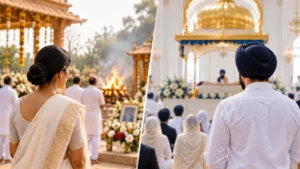
At first glance, a Sikh wedding and a Sikh funeral could not look more different, one filled with music, colour and celebration, the other quiet, reflective and centred on loss. Yet anyone who has attended both an Anand Karaj and an Antam Sanskar within the same Gurdwara will notice something striking, the same scripture open on the same stand, the same hymn sung at key moments, and the same underlying idea of union running through both events. Understanding this connection helps explain why Sikh families often describe a funeral, much like a wedding, as a moment of spiritual completion rather than simple loss, and why experienced funeral directors in UK who understand this theology tend to support Sikh families with far greater sensitivity than those unfamiliar with the tradition.
Four Sanskars That Shape a Sikh Life
Sikhism marks several major life events with a dedicated ceremony, or sanskar, and understanding these as a connected set rather than isolated occasions is the key to understanding the wedding and funeral link. Naam Karan marks the naming of a child, Amrit Sanchar marks formal initiation into the Khalsa, Anand Karaj marks marriage, and Antam Sanskar marks the final rite after death.
Each of these ceremonies takes place in the presence of the Guru Granth Sahib, follows a broadly similar structural logic, and is treated as an opportunity to remember Waheguru within the community, or Sadh Sangat, rather than as a private family milestone alone. Anand Karaj and Antam Sanskar sit at opposite ends of this sequence, marking the beginning of a shared life and its eventual conclusion, which is exactly why the parallels between them feel so deliberate rather than coincidental.
The Guru Granth Sahib as the Unmoving Centre of Both Ceremonies
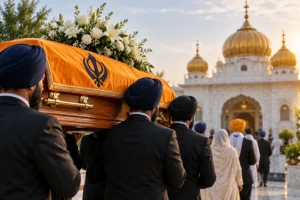
Both ceremonies place the Guru Granth Sahib at the physical and spiritual centre of everything that happens. At a wedding, the couple circles the scripture four times during the Lavan hymns, treating the Guru as a living witness to their union. At a funeral, the same scripture is read continuously or gradually in the days following a death, with the family gathering around it in the same posture of respect shown at a wedding.
This shared centring is not incidental. Sikh theology holds that the Guru Granth Sahib is not simply a book of teachings but the living Guru itself, meaning its presence transforms both a wedding and a funeral into an encounter with the same spiritual authority, rather than two unrelated cultural events that happen to involve prayer.
Anand Sahib: The Hymn That Names a Wedding and Closes a Funeral
Perhaps the clearest thread connecting the two ceremonies is the hymn Anand Sahib itself, composed by the third Guru, Guru Amar Das. This forty stanza composition gives Anand Karaj its very name, since Anand Karaj literally means the blissful ceremony, and the same hymn is recited again at the Bhog ceremony that closes a Sikh funeral’s mourning period.
- Anand Sahib provides the literal name for the wedding ceremony, since Anand Karaj translates directly as blissful union.
- The same forty stanza hymn is recited at Bhog, the ceremony marking the close of a funeral’s scripture reading.
- Both occasions treat the hymn as an expression of spiritual bliss rather than a reflection of the mood of the moment.
This is a striking theological choice. Rather than reserving a joyful hymn only for happy occasions, Sikh tradition uses Anand Sahib to frame both marriage and death as moments of bliss, since both represent a soul moving closer to union with the divine, whether through partnership in this life or return to Waheguru at its end.
The Theology of Union: From Atma and Parmatma to the Soul’s Return
The deeper connection between Anand Karaj and Antam Sanskar lies in how Sikh teaching defines union itself. The Lavan hymns sung at a wedding describe marriage as the joining of the human soul, or Atma, with God, or Parmatma, framing the couple’s relationship as a path that draws both partners closer to the divine rather than an end in itself.
Antam Sanskar draws on this exact same vocabulary of union, describing death as the soul completing its journey back to Waheguru. In both cases, the ceremony is not really about the two people, or the one person, at its centre, but about a relationship with the divine that the event either begins or brings to completion. This is why Sikh funerals avoid extended, sorrowful eulogies in much the same way weddings avoid excessive materialism, since both are considered spiritual milestones rather than purely personal or emotional occasions.
Ardas, Kirtan and Karah Parshad: The Shared Ritual Architecture
Beyond theology, the practical structure of both ceremonies overlaps significantly, and recognising this pattern helps guests unfamiliar with one event understand what to expect at the other.
- A formal Ardas prayer opens and closes both the wedding ceremony and the major stages of a funeral, including the Bhog.
- Kirtan, the singing of hymns from the Guru Granth Sahib, forms the musical and spiritual backbone of both occasions.
- Karah Parshad, the sacred sweet offering, is prepared and distributed to everyone present at both a wedding and a funeral.
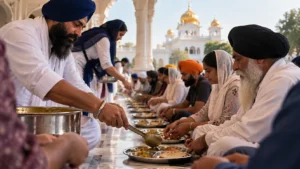
- Langar, the communal meal open to all regardless of background, follows both ceremonies as a practical expression of equality.
Guests who have attended one type of ceremony often recognise this architecture immediately at the other, even though the emotional tone of the room could not be more different, which is a testament to how consistently Sikh tradition applies its core principles across every major life event.
Simplicity and Restraint: A Value Present at Both Ends of Life
Sikh teaching consistently discourages excess, whether that means lavish, competitive wedding spending or prolonged, dramatic mourning at a funeral. The Anand Karaj itself was historically codified in part to move Sikh weddings away from elaborate Brahmanical rituals and toward a simpler ceremony centred entirely on the Guru Granth Sahib, and this same instinct toward restraint shapes the tone of Antam Sanskar, where lengthy, emotional eulogies are actively discouraged in favour of quiet acceptance.
This shared value of restraint reflects a consistent underlying belief, that outward display, whether of grief or celebration, distracts from the spiritual purpose both ceremonies are meant to serve.
No Priesthood, Only the Sangat: Who Leads Each Ceremony
A further point of connection lies in who is permitted to lead each ceremony. Sikhism has no ordained priesthood, meaning any respected member of the Sikh community, referred to as a Granthi when performing this role, can lead either an Anand Karaj or an Antam Sanskar, provided they are knowledgeable in the required prayers and conduct.
This egalitarian structure reinforces the idea that both marriage and death belong to the whole community, or Sangat, rather than to a religious hierarchy standing apart from it. For families arranging either event in the UK, this often means working closely with the same Gurdwara and, where a funeral is involved, Sikh Funeral Directors who understand how to coordinate with the Granthi and community appropriately, rather than treating the ceremony as something a funeral home manages independently.
A Practical Note on Legal Registration in the UK
While the spiritual structure of Anand Karaj and Antam Sanskar mirrors each other closely, UK law treats the two quite differently in terms of paperwork. A Sikh wedding held at a Gurdwara registered as a place of worship can usually be legally recognised without a separate civil ceremony, provided the Gurdwara holds the correct registration, while a death must always be formally registered through the standard civil process regardless of religious observance. Families planning either event should check the UK government’s official guidance on registering a death, which sets out the legal requirements that sit alongside, rather than replace, the religious ceremony itself.
Why This Connection Matters for Families Planning Either Event
Recognising the link between Anand Karaj and Antam Sanskar is more than an interesting theological observation, it shapes practical expectations for families and guests alike. A family arranging a funeral shortly after celebrating a wedding within the same community, or vice versa, will often find themselves working with the same Gurdwara, the same Granthi, and even some of the same hymns, which can be genuinely comforting during a difficult transition. It also explains why funeral directors experienced across the full range of Sikh life cycle events tend to bring a more complete, respectful understanding to their work than those who have only encountered isolated fragments of the tradition.
Support for Every Sikh Life Cycle Ceremony
Understanding how Anand Karaj and Antam Sanskar connect gives families a richer appreciation of Sikh tradition at both the happiest and hardest moments of life. When that moment is a funeral, Gooding Funeral Services offers genuinely experienced Sikh Funeral Directors, working closely with Gurdwaras and families across the UK to honour every element of the Antam Sanskar with the same respect shown at an Anand Karaj. Contact our team today to arrange a dignified, spiritually attuned funeral for your loved one.
Frequently Asked Questions
What does Anand Karaj mean?
Anand Karaj means blissful ceremony or blissful union, and it is the traditional name for the Sikh wedding ceremony, drawing its name directly from the hymn Anand Sahib recited during the event.
Why is the same hymn used at both Sikh weddings and funerals?
Anand Sahib is recited at Anand Karaj because it names the wedding ceremony itself, and it is recited again at Bhog, the closing ceremony of a Sikh funeral, because Sikh theology treats both marriage and death as forms of spiritual union rather than separate, unrelated categories of event.
Do Sikh weddings and funerals share the same structure?
Yes, both ceremonies centre on the Guru Granth Sahib, include a formal Ardas prayer, feature Kirtan hymn singing, and conclude with Karah Parshad and Langar, even though the emotional tone of each occasion is very different.
Who can lead an Anand Karaj or an Antam Sanskar?
Sikhism has no ordained priesthood, so any respected and knowledgeable member of the community, typically referred to as a Granthi in this role, can lead either ceremony on behalf of the family and the wider Sangat.
Does a Sikh wedding need to be legally registered separately in the UK?
If the Gurdwara is registered as a place of worship for marriages, the Anand Karaj can usually be legally recognised without a separate civil ceremony, though families should confirm registration status with their specific Gurdwara in advance.
Why do Sikh funerals avoid long, emotional eulogies?
Sikh teaching treats death as a natural transition of the soul back to Waheguru, and prolonged, sorrowful eulogies are seen as working against acceptance of this transition, echoing the same value of restraint found in the simplicity of the Anand Karaj wedding ceremony.