When a Sikh family loses someone they love, the mourning that follows rarely happens in isolation. Grief is shared, prayers are read together, and near the end of the ceremony, everyone present, family, neighbours, and strangers alike, sits down on the same floor to eat the same simple meal. This is Langar, and it is one of the most quietly powerful parts of Sikh funeral customs. Understanding why this communal meal matters helps explain much of what makes a Sikh funeral, known as the Antam Sanskar, feel less like an ending and more like an act of community.
This guide looks at where Langar comes from, how it fits into the structure of a Sikh funeral, and why it continues to offer comfort to grieving families across Punjab and across the Sikh diaspora in the United Kingdom.
What Is Langar?
Langar is the free vegetarian meal prepared and served in the community kitchen attached to every Gurdwara. It is open to absolutely everyone who walks through the door, regardless of religion, caste, gender, or financial standing. Volunteers cook, serve, and clean without payment, and no one is turned away or asked to pay for their food.
The word itself points to something larger than a meal. Langar represents three ideas that sit at the core of Sikh belief: sangat, the congregation or community; pangat, the practice of sitting together in a row as equals; and seva, selfless service given without expectation of reward. Together, these ideas turn a simple plate of dal and roti into a statement about how Sikhs believe human beings should treat one another.
The Origins of Langar in Sikh History
Langar traces back to Guru Nanak Dev Ji, the founder of Sikhism, in the late fifteenth century. As a young man, Guru Nanak was given money by his father to strike a profitable trade deal. Instead, he used it to feed a group of hungry holy men, calling this his true bargain, or Sacha Sauda. That single act became the seed of a tradition that has now fed millions of people for over five centuries.
Guru Amar Das Ji, the third Sikh Guru, turned Langar from a symbolic gesture into a formal institution. He is remembered for insisting that visitors, including the Mughal Emperor Akbar, sit in Pangat and eat Langar before receiving an audience with him, regardless of their rank or wealth. Guru Angad Dev Ji’s wife, Mata Khivi Ji, is separately honoured in Sikh scripture for expanding Langar and ensuring it was prepared with generosity and care. By the time of the later Gurus, Langar had become inseparable from the identity of the Gurdwara itself.
Langar’s Place Within Sikh Funeral Customs
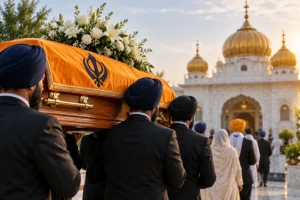
A Sikh funeral, known as Antam Sanskar, follows a fairly consistent structure, though timing can vary between families and countries. Langar appears at more than one point in this process, but its most significant role comes at the very end, during the Bhog ceremony.
- Antam Sanskar begins soon after death, usually within a few days, with the body washed and dressed by family members as an act of seva.
- Cremation is the accepted practice in Sikhism, carried out after Ardas, the closing prayer asking for blessings on the departed soul.
- A complete reading of the Guru Granth Sahib often follows, either as an Akhand Path completed over roughly forty-eight hours or a Sehaj Path spread across a longer period.
- The Bhog ceremony marks the conclusion of this reading, usually around ten days after the death, and closes with Ardas, Hukamnama, and the sharing of Karah Prashad.
- Langar is then served to everyone present, marking the point where mourning formally gives way to communal support and a gradual return to daily life.
Because Sikhism does not prescribe long mourning rituals or fixed periods of visible grief, the Bhog and its Langar act as a natural, communal marker that helps a family move from acute loss toward ongoing life, supported by their sangat rather than left to grieve alone.
Why the Communal Meal Matters So Much
It would be easy to see Langar after a funeral as simply a practical way to feed a large gathering, but its significance runs deeper than logistics.
- It removes the burden of hosting from a grieving family, since Gurdwara volunteers cook and serve the meal at no cost to anyone.
- It reinforces that death, like life, does not create hierarchies, because everyone eats the same food while sitting on the same floor.
- It gives mourners a natural, unforced setting in which to offer condolences, share memories, and simply sit with the bereaved family.
- It turns individual grief into a shared experience, reminding the family that the wider sangat carries part of their sorrow with them.
- It reflects the Sikh belief that feeding another person is itself a form of prayer and an act of genuine seva.
Grief researchers and hospice chaplains have long noted that shared meals after a death help mourners process loss and stay connected to support networks. Sikh tradition arrived at this same insight many centuries before it became a subject of academic study.
Attending a Sikh Funeral: Etiquette Around Langar
Non-Sikh friends, neighbours, and colleagues are always welcome to attend a Bhog ceremony and share in Langar, and doing so is generally seen as a meaningful way to show support. A few simple points of etiquette make this easier for anyone attending for the first time.
- Cover your head with a scarf or cloth before entering the Gurdwara hall, as a mark of respect for the space.
- Remove your shoes at the entrance and leave them in the designated area that is provided for visitors.
- Sit on the floor in Pangat alongside everyone else, rather than seeking out a chair or a separate table.
- Accept food with both hands cupped together, and take only as much food as you intend to eat.
- Offer to help with serving or clearing away afterwards, since volunteering is itself considered an honour, not an obligation.
Sikh Funerals in the UK: What Families Should Know
Arranging a Sikh funeral in the UK involves the same legal steps required for any death, alongside the religious customs described above. A death must be registered within five days in England and Wales, or eight days in Scotland, and a Certificate for Burial or Cremation must be obtained before a cremation can proceed. Full guidance on this process is available directly from GOV.UK’s official guide on what to do after a death, which covers registration, the Tell Us Once service, and coroner involvement where relevant.
Because cremation must fit around UK administrative timelines, families often cannot hold the funeral within the traditional three days, and experienced funeral directors in UK play an important part in coordinating with the Gurdwara, the Granthi, and the crematorium so that Sikh customs are respected as closely as possible within these constraints. National bodies such as Sikh Council UK also offer guidance to Gurdwaras and families navigating these arrangements.
At Gooding Funeral Services, our team regularly supports families through every stage of Antam Sanskar, from the initial call through to the Bhog ceremony and Langar, working closely with local Gurdwaras across Leeds, Bradford, Huddersfield, Doncaster, and Manchester.
Conclusion
Langar sits at the heart of Sikh funeral customs precisely because it refuses to separate mourning from community. A meal that costs nothing and excludes no one turns a family’s private grief into something the whole sangat shares, one plate at a time. Whether you are a Sikh family planning an Antam Sanskar or a guest attending your first Bhog ceremony, understanding Langar’s history and meaning makes the experience richer and more respectful.
If you are arranging a Sikh funeral in the UK and want guidance from a team that understands these customs in depth, Gooding Funeral Services is available twenty four hours a day, seven days a week, to help. As trusted sikh funeral directors in UK, our team can coordinate Antam Sanskar arrangements, Gurdwara liaison, and Langar with the care your family deserves.
Frequently Asked Questions
What does Langar mean in Sikhism?
Langar is the free communal meal served at every Gurdwara, cooked and served by volunteers, and offered to anyone regardless of religion, caste, or background as an expression of seva and equality.
Why is Langar served at Sikh funerals?
Langar is served at the Bhog ceremony that closes the Antam Sanskar, providing the grieving family with practical support and giving mourners a shared, unhierarchical way to offer condolences.
Who started the tradition of Langar?
Guru Nanak Dev Ji began the practice in the late fifteenth century, and Guru Amar Das Ji, the third Sikh Guru, later formalised it as a required institution at every Gurdwara.
Can non-Sikhs eat Langar at a funeral?
Yes. Langar is open to everyone regardless of faith, and non-Sikh guests attending a Bhog ceremony are welcome and encouraged to sit and share the meal.
How soon after death is a Sikh funeral held in the UK?
Sikh tradition favours cremation within a few days, but UK legal requirements around death registration and medical certification typically mean funerals take place within five to ten days.
Do you need to bring anything to a Sikh funeral Langar?
No. Langar is entirely free, and guests are not expected to bring food, money, or gifts, though donations to the Gurdwara are always welcomed.