Few things worry first time guests more than getting their clothing wrong at a Hindu or Sikh funeral. The anxiety is understandable, because the dress code differs from the black clothing most British people associate with funerals, and the cost of a misstep feels high when a family is grieving. The reassuring truth is that families care far more about your presence than your outfit, and a few simple principles will keep you comfortably on the right side of respect. This guide, shaped by the experience of funeral directors in UK who attend Hindu and Sikh services, explains exactly what to wear, what to carry and what to avoid.
A Safe Outfit for Either Funeral
If you want one answer that works for both traditions, choose modest, loose or well fitted clothing in white, cream or soft pale colours, covering your shoulders and knees, and carry a scarf or head covering in your bag. Wear shoes that are easy to remove, keep jewellery understated, and avoid bright colours, particularly red. This combination suits a crematorium, a gurdwara, a temple and a family home, which means you will not be caught out wherever the day takes you.
Why White and Not Black?
In Hindu and Sikh traditions white is the colour of mourning. It represents purity, peace and the soul’s release from the physical world, rather than the heavy sorrow that black signals in Western custom. Close family members often wear white from the day of death through the mourning period, so guests who also wear white or pale colours show solidarity with them.
Context matters, though. In the UK, many non-Hindu and non-Sikh guests attend in subdued dark colours and families are rarely offended, particularly at Sikh services where navy, grey and charcoal are widely accepted. For Hindu funerals, many families prefer guests to avoid black, so if you are unsure, white, cream or pale grey is the safest choice. When in doubt, a quiet message to a family member or the funeral director settles the question in seconds.
What Men Should Wear
- A plain white or cream shirt with smart trousers in a light, muted shade is appropriate for both Hindu and Sikh funerals.
- A kurta pyjama in white or cream is traditional, though no one expects non-South Asian guests to own one.
- A light, plain suit works well, and a tie is optional rather than expected at most services.
- Long trousers are preferred over shorts, even in summer, and sleeves should cover the upper arms.
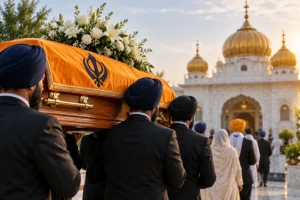
For a Sikh funeral, men also need a head covering inside the gurdwara. A simple handkerchief style cloth, a cap or a patka is sufficient, and Sikh men who wear turbans will naturally keep them on.
What Women Should Wear
- A white or cream salwar kameez with a dupatta is traditional and doubles as a head covering when needed.
- A white or pale saree is common among Hindu women, though non-Hindu guests are never expected to wear one.
- Modest Western outfits such as a long skirt or loose trousers with a long sleeved top in pale tones are equally welcome.
- Avoid sleeveless tops, low necklines, short hemlines and heavily sequinned or patterned fabrics that draw attention.
Keep makeup and jewellery light. Heavy gold, bold lipstick and strong perfume feel out of place at a solemn service, particularly in a small enclosed chapel.
Head Coverings: Essential at a Sikh Funeral
The most important rule at a Sikh funeral is the head covering. Everyone who enters a gurdwara, whatever their faith, gender or age, covers their head as a mark of respect for the Guru Granth Sahib. Most gurdwaras keep spare cloths, called rumals, at the entrance for visitors, but bringing your own avoids any awkwardness.
- Women can use a dupatta, shawl or large scarf, ideally in white, cream or another soft colour.
- Men can use a clean cotton handkerchief, a plain cap or a patka, tied securely so it stays in place.
- Children also need their heads covered inside the gurdwara, so pack a small scarf or cloth for them too.
At a Hindu funeral, a head covering is not generally required at a crematorium, though some women choose to cover their heads with a dupatta or pallu inside a temple or during prayers, so having a scarf with you is wise either way.
Footwear and Practical Details
Shoes are removed before entering a gurdwara, a Hindu temple or a family home, so choose footwear you can slip off easily and wear clean, intact socks or tights if you prefer not to be barefoot. Avoid anything with complicated laces or straps if you will be moving between venues. Leather items are sometimes avoided inside a Hindu temple, so it can be considerate to leave a leather belt or bag in the car if you are heading to a temple after the crematorium. Floor seating is common at gurdwaras and at home gatherings, so wear clothing that lets you sit cross legged comfortably and avoid pointing your feet toward the Guru Granth Sahib or the family.
Dressing for the UK Weather and the Venue
British weather rarely cooperates with a dress code, so plan layers. A plain cream or white cardigan, shawl or light jacket can cover bare arms in summer and keep you warm in a cold crematorium chapel. In winter, choose a long coat in a muted shade, and bring a scarf that can serve as both warmth and head covering.
- A crematorium service is usually shorter and more Western in format, so smart modest clothing is perfectly acceptable there.
- A gurdwara requires a head covering, bare feet or clean socks and comfortable clothing for floor seating.
- A family home visit calls for simple pale clothing, shoes you can remove and a quiet, respectful manner.
- Rain is common, so carry a plain umbrella in a neutral colour rather than a bright or patterned one.
What to Avoid
- Bright colours, especially red, which is associated with celebration and weddings, are considered inappropriate at a funeral.
- Flashy jewellery, heavy accessories and designer logos tend to attract attention that a grieving family does not want.
- Revealing, tight or sheer clothing is disrespectful at a religious service regardless of the weather.
- Strong perfume or aftershave can be overwhelming in small spaces and is best skipped altogether.
If you are supporting a family who are still arranging the service, practical guidance is available through the UK government’s guide on what to do when someone dies, which explains registration and next steps.
Attend With Confidence and Respect
Dressing thoughtfully is a simple way to support a grieving family, and the effort is always appreciated even if it is imperfect. If your own family is arranging a Hindu or Sikh funeral and would value guidance on every detail, from dress codes to ceremonies, Gooding Funeral Services provides experienced, culturally aware Hindu Funeral Services and Sikh Funeral Directors. Contact our team today for compassionate support.
Frequently Asked Questions
- Do I have to wear white to a Hindu funeral?
White or pale colours are preferred and are the safest choice, but non-Hindu guests are not expected to wear traditional dress. Modest, muted clothing is accepted, and many families would rather you attend in plain clothes than stay away.
- Can I wear black to a Hindu or Sikh funeral?
Black is widely avoided at Hindu funerals, so white, cream or pale grey is safer. At Sikh funerals in the UK, subdued colours such as navy, grey and charcoal are generally accepted, though white remains the traditional colour.
- Do I need to cover my head at a Sikh funeral?
Yes, everyone entering a gurdwara covers their head, regardless of faith or gender. Most gurdwaras provide spare cloths at the entrance, but bringing your own is considerate.
- What should children wear to a Hindu or Sikh funeral?
Children should wear simple, modest clothing in pale or muted colours, with easy to remove shoes. For a gurdwara, they also need a small head covering.
- Should I take my shoes off at a crematorium?
Usually not, because UK crematoria follow standard practice. Shoes are removed at a gurdwara, a temple or a family home, so wearing easy to remove footwear keeps you prepared.
- Is it okay to wear a suit to a Hindu or Sikh funeral?
Yes, a plain, light coloured suit is appropriate for men. Choose white, cream or soft grey rather than black, and keep accessories minimal.